Context
Every project I make needs somewhere to live. Instead of a portfolio template, the site became a project of its own: a home for the games, tools, and experiments I build, and a place to try ideas out in public.
Problem
Most personal sites are a résumé with a header image. They tell you someone can build things without letting you touch any of it. I wanted the opposite: every link goes to something that runs, in the browser, with nothing to install.
And it had to feel like mine — a little unserious, hand-made, alive — without getting in the way of finding the work.
What I built
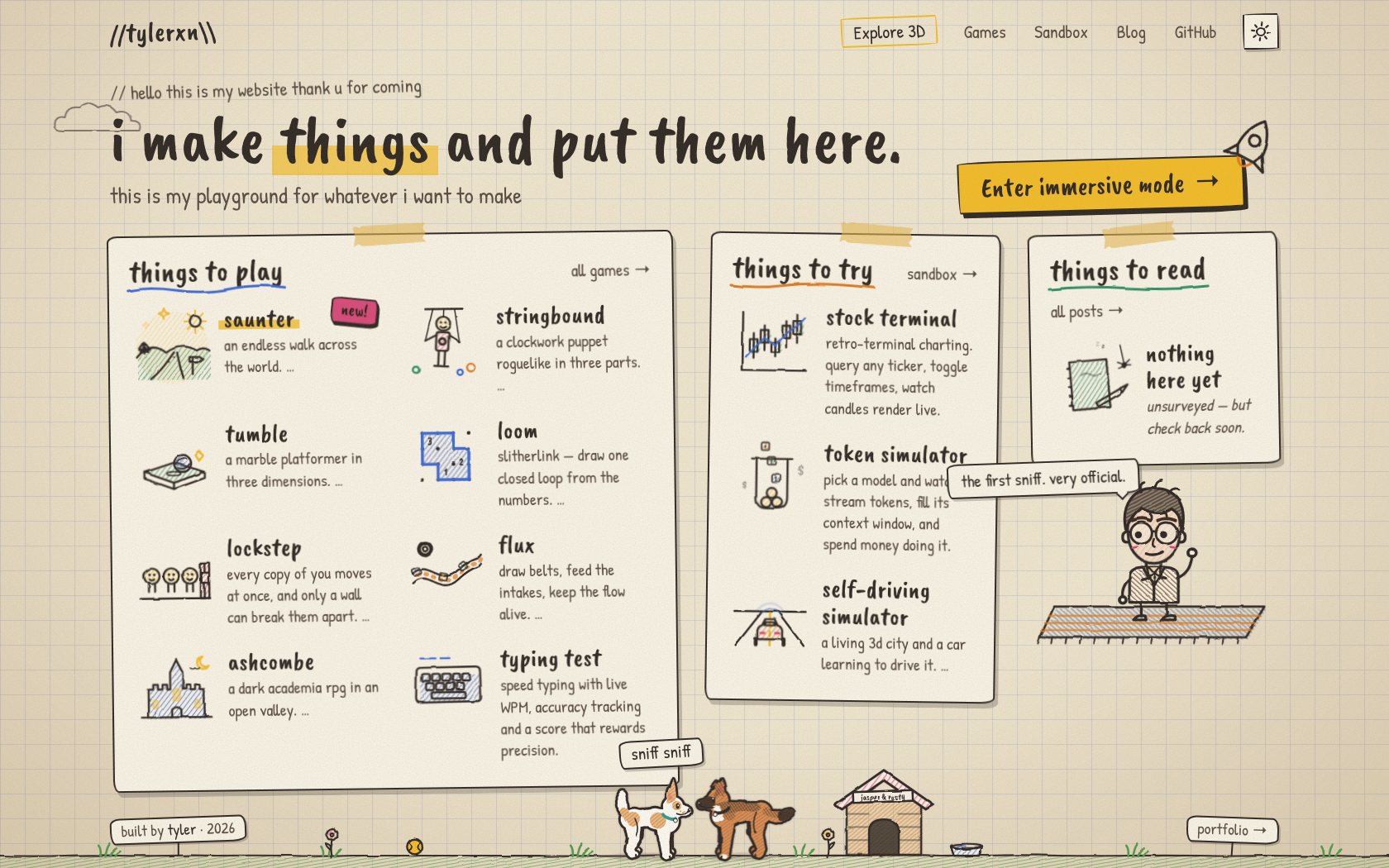
A static site in plain HTML, CSS, and JavaScript — no framework, no build step. The front page is a hand-drawn sketchbook: every line redraws itself a few times a second, the paper shifts under your cursor, and a doodle of me comments on whatever you point at. Two dogs, Jasper and Rusty, live in a yard along the bottom; each is a small 3D puppet with jointed legs, posed and drawn every frame.
Behind it: an arcade of browser games (logic puzzles like Loom and Lockstep, a 3D marble platformer, a factory logistics game, an RPG), a sandbox of tools — a stock terminal, a token simulator, a self-driving car sim — and a 3D hub you fly around in a rocket. This portfolio is part of it too.
How it works
- Each project is self-contained: its own page, its own code, nothing shared it doesn't need
- Plain HTML, CSS, and JavaScript everywhere; Three.js where it needs 3D
- The hand-drawn look is one trick: an SVG displacement filter whose noise changes a few times a second, so every line wobbles like it's being redrawn
- Dark and light paper, remembered across the site
- Built to work on a laptop and on a phone
Status / next
Always in progress — that's the point. New games and tools land here first. Next: the first posts on the blog, and whatever the next idea turns out to be.